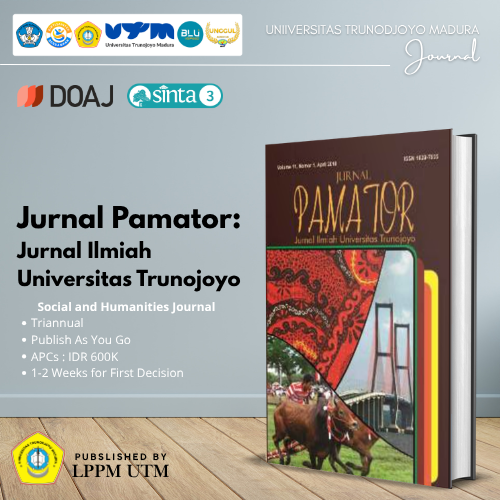
The mission of Jurnal Pamator is to serve as the premier peer-reviewed, interdisciplinary journal to advance theory and practice related to all forms of social science. This includes highlighting innovative endeavors; critically examining emerging issues, trends, challenges, and opportunities; and reporting on studies of impact in the areas of social sciences and humanities.
Jurnal Pamator published triannually (three times a year) January – April, May – August, and September – December.
Aims and Scope
Jurnal Pamator aims to provide a forum for international researchers on applied social sciences to publish the original articles.
The scope of this journal is the study of regional development from a legal, economic, and educational perspective.
1. Legal Perspective
This includes studies on:
Regional regulations and local governance, Land use and spatial planning laws, Legal frameworks for regional autonomy and decentralization, Dispute resolution mechanisms at the regional level, Legal aspects of natural resource management in specific regions (e.g., Madura), Compliance and enforcement of regional policies
2. Economic Perspective
This includes studies on:
Regional economic growth and development strategies, Local industry, small and medium enterprises (SMEs), and entrepreneurship, Tourism economics and creative economy at the regional level, Infrastructure development and its economic impact, Regional labor markets, poverty alleviation, and income distribution, Economic aspects of agriculture, fisheries, or maritime sectors (relevant to coastal regions like Madura), Financial management of regional governments
3. Educational Perspective
This includes studies on:
Educational policy and its role in regional human capital development, Access to and quality of education in rural or underdeveloped regions, Vocational training and workforce development aligned with regional needs, Community education and lifelong learning programs, The impact of educational institutions (e.g., universities) on local development, Curriculum adaptation to local culture and economic conditions


Reviews
There are no reviews yet.